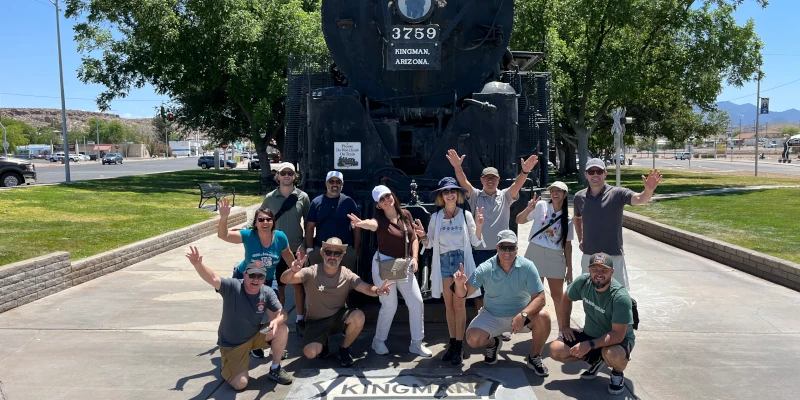
In May 2026, we took a group of Brazilian travel agents through the longest uninterrupted stretch of Route 66 as part of the Las Vegas Immersion program. What initially looked like a scenic day trip turned into something else entirely. Route 66 is still alive because there are people who wake up every single day to keep it that way — and most travelers passing through have no idea.
The Arizona Stretch of Route 66: the Longest and Best Preserved
Route 66 was officially established on November 11, 1926. It spans 2,448 miles, connecting Chicago in the Midwest to Santa Monica, California — eight states, dramatically different landscapes, and decades of American history paved into asphalt.
The Arizona stretch is the longest uninterrupted section of the route — and, for many, the most cinematic. Departing from Las Vegas, the group crossed into Arizona and followed an itinerary that began in Kingman, passed through Antares and Hackberry, and ended in Seligman, the town that inspired Radiator Springs in Pixar’s Cars. Diners serving the same menu they’ve had for decades. Gas stations that seem frozen in time because someone consciously decided preserving that time was worth the effort.
Who Keeps Route 66 Alive: Volunteers, Associations, and History
Most tourists driving along the Mother Road have no idea that the highway they’re photographing still exists because volunteers wake up every day to keep it standing.
Route 66 associations — such as the Historic Route 66 Association of Arizona, with which American Journeys / Trips on 66 is affiliated — are made up of people who chose, without compensation, to preserve a legacy that would simply disappear without them.
Many are descendants of those who lived through the Great Depression. During the 1930s, when the economic crisis forced entire families to leave their homes, Route 66 became the road of migration. Those who traveled it carried with them a way of treating others — stopping, helping, sharing — that remained in the towns along the way.
Today, these associations work with government agencies to secure funding, restore historic buildings, organize events, and continue bringing new visitors to the route. The result can still be seen in the buildings that remain standing today.
Kingman, the Heart of Route 66
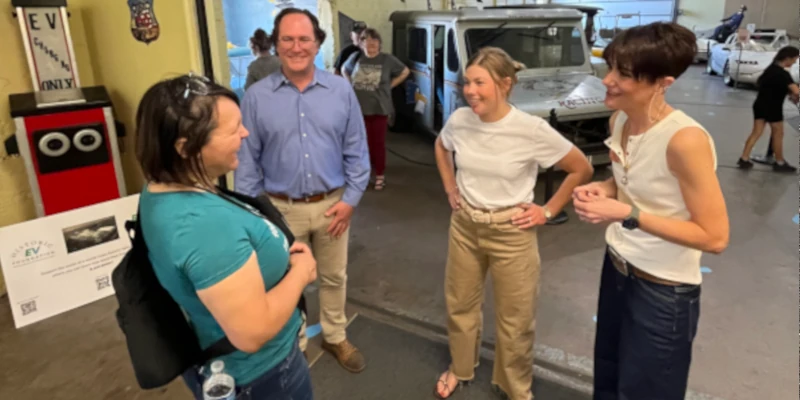
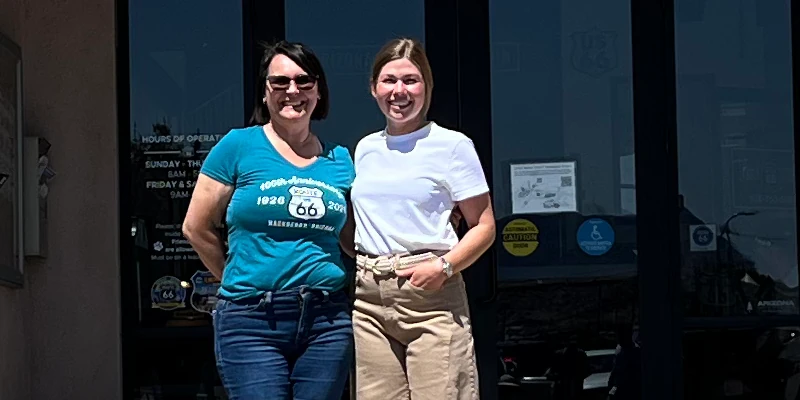
The visit to the Arizona Route 66 Museum was not originally part of the day’s itinerary. The Route 66 associations had just come off a full week of centennial events, and the group arrived at the Powerhouse Visitor Center without a scheduled appointment inside the museum. The meeting with Nikki Terlesky, president of the Historic Route 66 Association of Arizona, happened organically — and she, alongside Leah Stagg, offered complimentary admission to the entire group.
The group arrived already understanding the context of the building itself — a power plant built in 1907 that today houses, under the same roof, the association’s headquarters, the visitor center, the electric vehicle museum, and the Arizona Route 66 Museum. Nikki and Leah introduced the group to the museum’s current phase: the recent redesign of the space, the investment in the new timeline exhibition that tells the story of the route’s earliest travelers and the people who settled in the region, and they remained available throughout the visit to answer every question the group had.
Leah Stagg comes from the Mohave County Museum. The two institutions joined forces recently, and Leah became responsible for the Arizona Route 66 Museum, co-leading the complete redesign of the space.
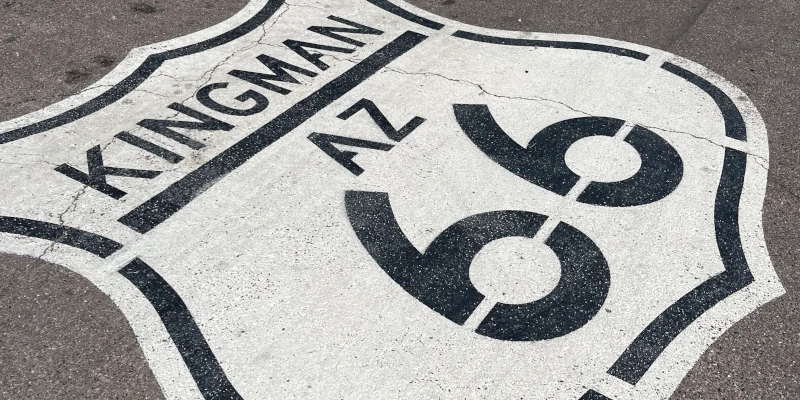
The signs scattered throughout the city leave no doubt: The Heart of Route 66.
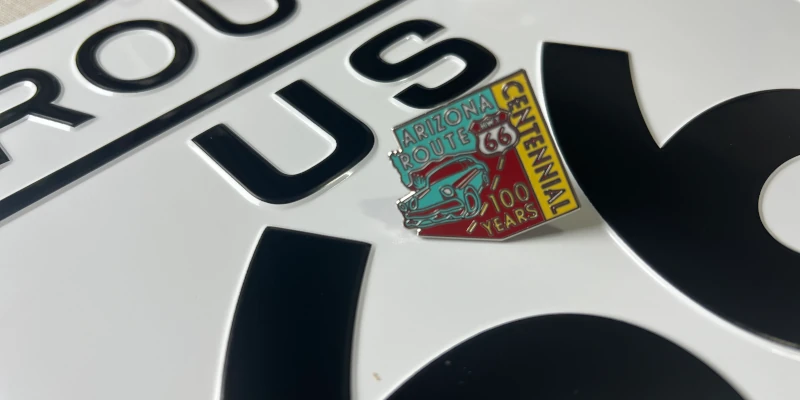
Before leaving, the group was also gifted a commemorative Route 66 centennial pin.
We would like to publicly thank Nikki and Leah. Welcoming a group of Brazilians with such generosity and enthusiasm is exactly the kind of gesture that keeps alive the spirit they work so hard to preserve.
Why Signing the Guest Book Matters More Than It Seems
There’s one detail along Route 66 that may look like bureaucracy, but it isn’t: the guest book.
In many places along the route, visitors are invited to sign books registering their name and hometown. For local communities, those signatures mean that people from other countries came all the way there, cared enough to stop, and will carry those stories back home. When you sign, you are confirming that their work reaches beyond their own town. That it’s worth continuing.
When you post about it, recommend it, or bring clients there, the chain extends further. That is the real fuel that keeps the route alive.
American Journeys / Trips on 66 and Route 66
American Journeys and Trips on 66 maintain a real relationship with the route’s associations. We participate in events, stay connected with local communities, and bring Brazilian groups to these places with the context they deserve.
In 2026, the centennial year, Trips on 66 operates both itineraries covering the Mother Road: the Arizona stretch — either as a guided caravan or in a private Sprinter van — and the complete Chicago-to-Los Angeles journey across all eight Route 66 states. In every format, travelers are accompanied by a specialized Portuguese-speaking guide, experience stops filled with history, and gain access to places most independent travelers simply drive past without noticing.
A hundredth anniversary only happens once.
And this is a story best experienced alongside the people who dedicate their lives to keeping it alive.